

Ask a modern language model to “think again” and it doesn’t slowly glide toward a single correct answer. It jumps, circles, hesitates, and eventually settles, often in one of several distinct, stable stories it knows how to tell.
We made that motion visible. Across 11 frontier models, 8 reflection scaffolds, and 13K prompts (for a total of 104,896 reflection loops), we embed every intermediate answer into a shared semantic space and watch what happens when models reflect on themselves up to seven times.
In Part I Geometry of Reflection: How AI Models Think in Curved Space, we introduced the idea that reflection in AI models could be measured as motion through semantic space. We watched four providers rethink their own answers and found that different models think in different shapes.
In Part II Geometry of Reflection: How Models Move Through Meaning, we scaled up massively: 11 models from 6 provider families, 13,000 prompts, 8 reflection scaffolds, 104,896 total reflection loops. We mapped how meaning moves when models reconsider, measuring curvature, effort, and stabilization across the full landscape.
But those analyses focused on motion. This essay expands on the research detailed in Part II and focuses on destination.
Kinematics describes how things move. Topology describes the shape of the space they move through. The central question shifts from “how does the model move?” to “where does it end up, and what’s the shape of the region that drains there?”
The heatmaps and violin plots from our scaled experiment reveal something we didn’t expect: reflection dynamics aren’t continuous. Models don’t gradually converge. They fall into basins.
Throughout, ‘landscape’ means the geometry induced by a single universal embedder (E5-Mistral-7B). In provider-native spaces the variance splits differently (architecture dominates). So when we say a style ‘organizes the manifold’ or an architecture has a particular ‘gait,’ those are properties of how their outputs look through this measurement lens, not necessarily of their internal activations.
Architecture as Gait
The first major finding: provider families have consistent dynamic signatures that persist across prompts, domains, and reflection scaffolds. These signatures manifest in step size, exploration radius, curvature, and stabilization timing.
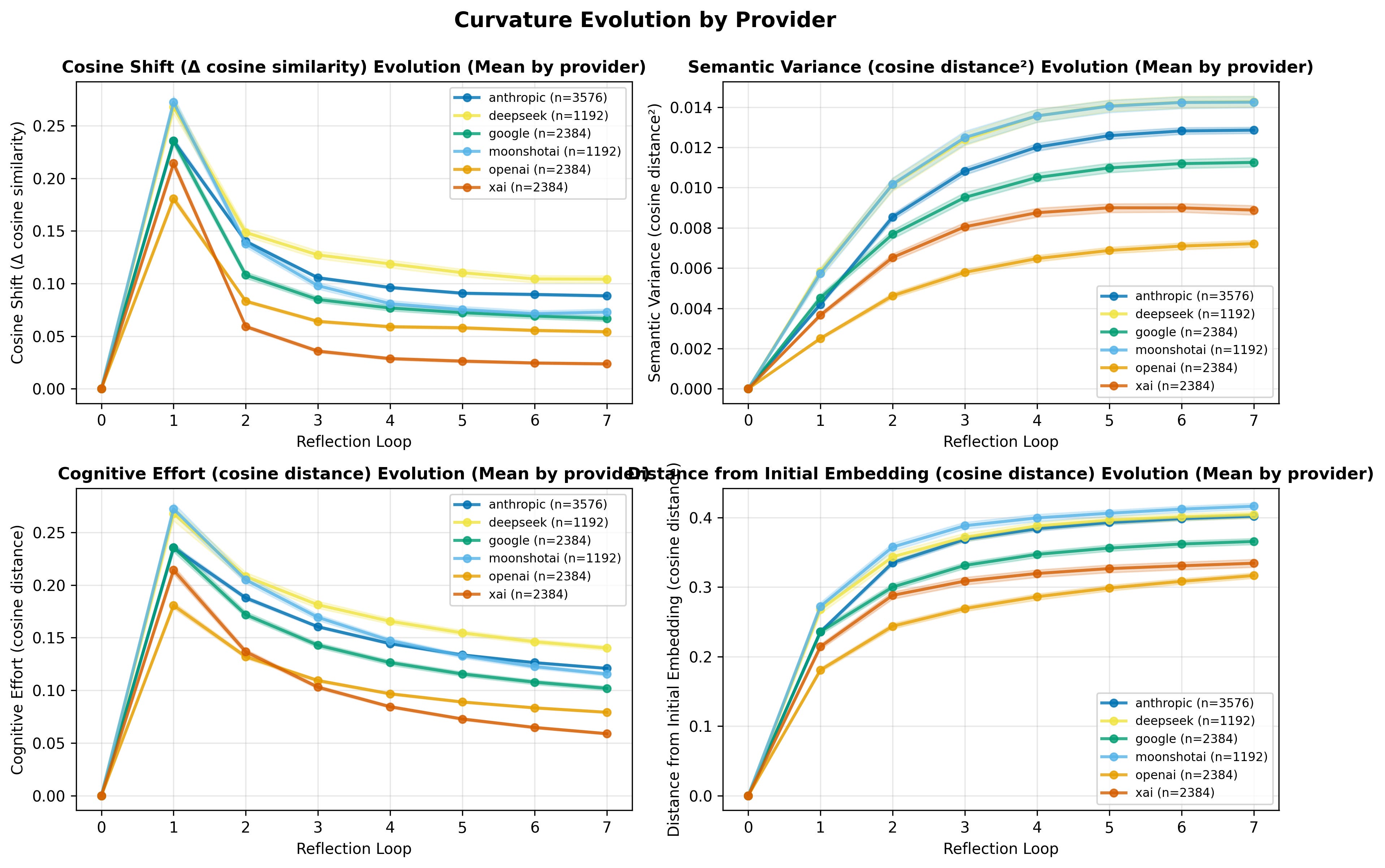
Curvature Evolution by Provider. Average cosine shift, semantic variance, cognitive effort, and distance from initial embedding across eight loops, aggregated by provider. Larger early steps and slower decay indicate more exploratory “gaits.”
These gait differences are real at the level of averages, but in the E5-Mistral embedding space they are subordinate to scaffold effects: reflection style explains roughly 1.7–3.6× more variance in the manifold than provider identity. Architecture sets how a model walks; scaffolds still do more to organize where the walks cluster.
The Exploratory Cluster: DeepSeek, Moonshot, Anthropic
On these provider averaged curves, DeepSeek and Moonshot sit at the exploratory pole, with Anthropic’s Claude close behind.
In cosine shift and cognitive effort, DeepSeek climbs the highest at the first reflection step and stays above the other families across later loops. Semantic variance shows the same pattern: DeepSeek sweeps out the broadest cloud of points, followed by Moonshot and Anthropic. Distance from the initial embedding shows all three moving farthest from where they started and staying there.
Taken together, DeepSeek, Moonshot, and Anthropic’s Claude form an exploratory cluster. They take large first steps, keep spending effort through the middle loops, and end up well away from their starting point. At the level of averages, these architectures reliably explore rather than just nibbling locally.
The Conservative Pole: xAI
xAI’s Grok sits at the opposite extreme. Across all four panels it shows the smallest initial displacement, the lowest semantic variance, and the shortest distance from its starting point. Its curves rise only modestly at the first reflection step and then decay quickly toward a flat line.
In other words, xAI commits early and does not wander far. Reflection for these models looks more like local polishing than wide angle search.
The Middle Band: OpenAI and Google
OpenAI and Google’s Gemini fall in the middle. Their curves sit between the exploratory cluster and xAI on step size, variance, and displacement. They move more than xAI but less than DeepSeek or Moonshot, and their effort decays in a smoother, more moderate way.
For OpenAI, these averages are already a good summary of its behavior. For Gemini, the more interesting fact is how little its curves change when you swap scaffolds, something that shows up clearly when we look at the provider by style heatmaps later on.
Gait as Biomechanics
The metaphor that captures this finding is that architecture is biomechanics. Just as people have characteristic gaits determined by leg length, joints, and muscle distribution, LLM architectures have characteristic reflection gaits determined by training, scale, and alignment procedures.
We do not know the exact causal knobs, but we can see the effect: change the prompt all you want, Claude still walks like Claude, Grok still walks like Grok, and DeepSeek, Moonshot, and Anthropic all look like members of the same long stride family.
Scaffolds as Terrain
With architectural gait established as baseline, we can layer reflection scaffolds on top. Scaffolds don’t replace the legs. They reshape the terrain.
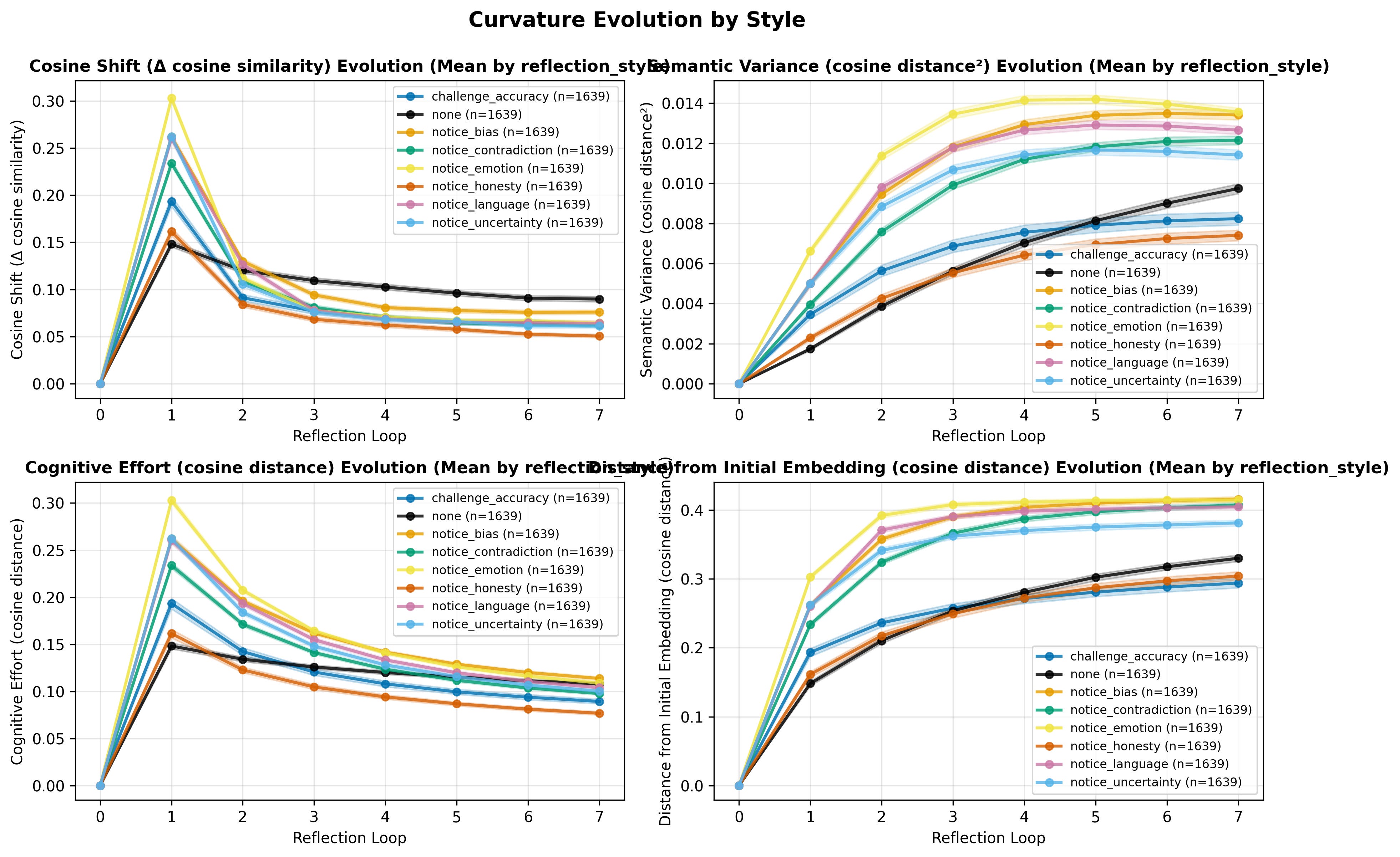
Curvature Evolution by Reflection Style. Mean per-loop metrics by scaffold. “Expansion” styles (notice_emotion, notice_uncertainty, notice_language) maintain greater curvature and variance than “directional” styles (challenge_accuracy, notice_bias, notice_honesty).
Expansion-Oriented Scaffolds
notice_emotion, notice_uncertainty, and notice_language form a cluster of expansion-oriented scaffolds. They:
Often raise local change magnitude by roughly 50% over the no-scaffold baseline
Increase exploration radius
Delay stabilization
Produce more high-curvature, high-variance trajectories
These scaffolds act like hiking uphill in wind. They inject energy into the system, forcing the model to work harder and cover more ground before settling.
Directional Scaffolds
challenge_accuracy, notice_bias, and notice_honesty behave differently. They:
Increase path length without proportional variance spikes
Push trajectories into selective regions
Produce slightly earlier stabilization
Generate smoother flows with lower curvature
These scaffolds act like a well-graded trail. They channel movement rather than amplifying it, guiding trajectories toward specific semantic regions rather than expanding the search space.
The Contradiction Oscillator
notice_contradiction deserves special attention. It can induce oscillatory dynamics: back-and-forth movement between competing interpretations before eventual settling. This isn’t just amplitude modulation. It’s a qualitatively different dynamic mode, suggesting that some scaffolds can induce phase changes in the reflection process rather than merely scaling existing behavior.
The Decomposition
Quantitatively, in E5-Mistral, style accounts for about 17% of distance variance where provider accounts for about 10%; in 2D UMAP projection the gap widens to ~36% vs 6%. The pictures in this essay are a narrative zoom-in on that reflection style dominant topology result.
A clean decomposition emerges:
Architecture = Gait Scaffold = Terrain and Weather Same walker, different terrain → different trajectory
But this framing raises a question: is the scaffold effect additive or multiplicative with architecture? Does applying notice_emotion to both Anthropic and xAI add a constant offset to their curves, or amplify each proportionally?
The heatmaps answer this decisively.
The Interaction Puzzle
So we have gait (architecture) and terrain (scaffold). You might expect these to combine simply: exploratory architecture + expansion scaffold = extra exploration. Conservative architecture + directional scaffold = extra focus. The data say otherwise.
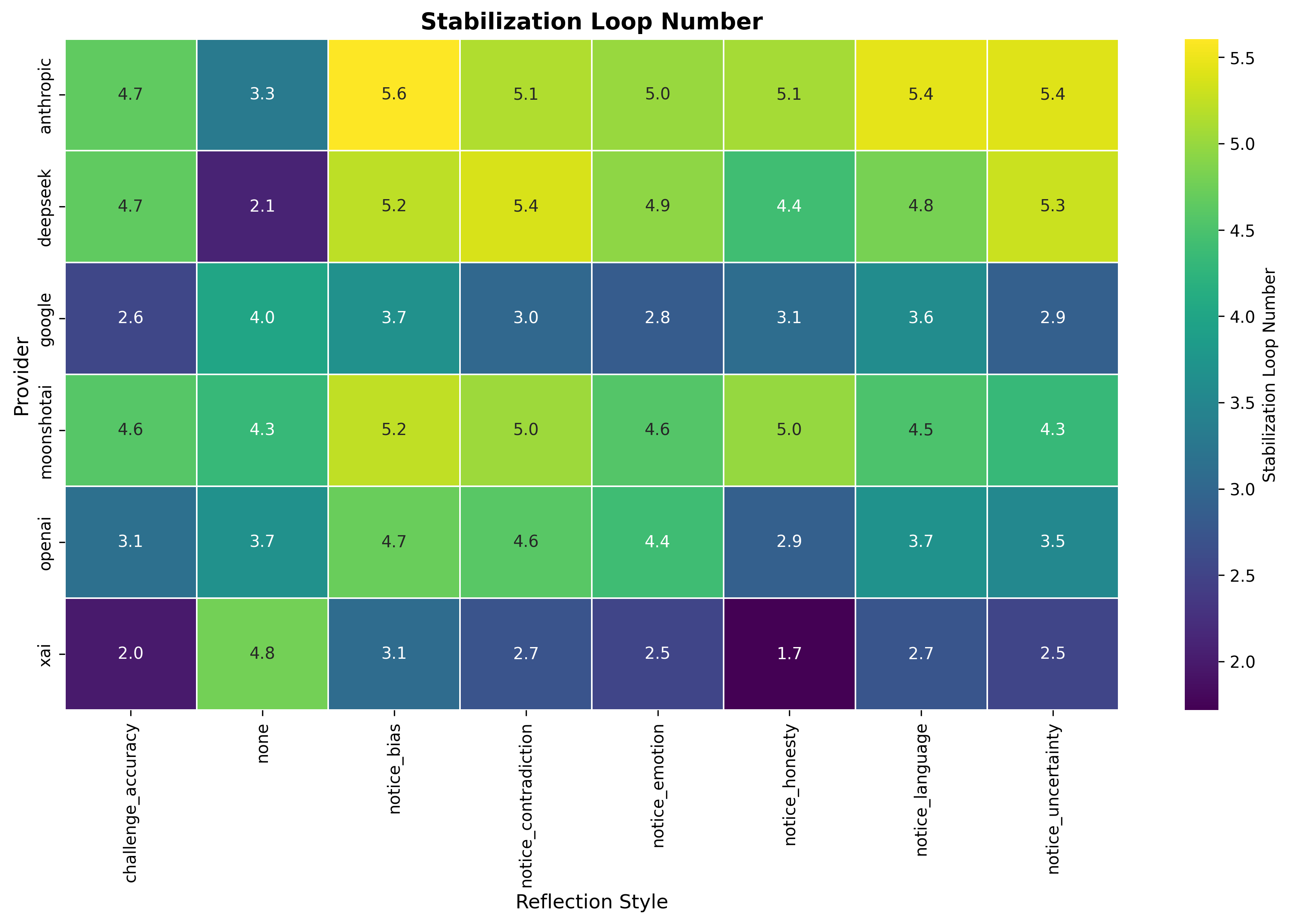
Stabilization Loop Number by Provider and Reflection Style. Lower values indicate faster convergence; higher values indicate prolonged reflection. The patterns here overturn simple intuitions about how scaffolds affect different architectures.
Look at the xAI row. Under none, with no reflection scaffold at all, xAI stabilizes slowly: 4.8 loops, the longest in its row. Add notice_honesty and it drops to 1.7 loops. Add challenge_accuracy and it’s 2.0.
This is backwards from what you’d expect. Scaffolds should add complexity, right? More to think about, longer to settle?
Not for xAI. For this architecture, scaffolds act as constraints that channel and focus rather than perturbations that expand. The architecture wants to wander without guidance; reflection scaffolds give it rails, allowing it to commit faster.
Now look at DeepSeek. Under none, it’s almost dormant: fast stabilization (2.1 loops), low effort, minimal variance. But add challenge_accuracy and stabilization delays to 4.7 loops. Add notice_bias and the whole system activates.
DeepSeek isn’t a low-energy architecture. It’s a scaffold-responsive architecture. The baseline behavior looks more like waiting than working. The reflection instruction doesn’t add energy to existing motion; it unlocks a different operational mode entirely.
Google shows a third pattern: its row is nearly flat. Stabilization ranges only 2.6–4.0 regardless of scaffold. Compare to Anthropic’s range of 3.3–5.6 or DeepSeek’s 2.1–4.7. Google’s gait is impervious to terrain.
Two scaffolds show consistent effects across all architectures. notice_honesty suppresses. It collapses exploration space, producing the lowest effort and fastest stabilization almost everywhere. Attending to honesty narrows the viable response region; the model finds what it considers honest and stops searching. notice_bias does the opposite. It runs hot everywhere, delaying stabilization, maintaining exploration. There’s always another potential bias to find, another angle to examine.
Energy and Spread: The Full Picture
The stabilization heatmap tells us when trajectories settle. But two other heatmaps reveal how hard they work and how far they roam.
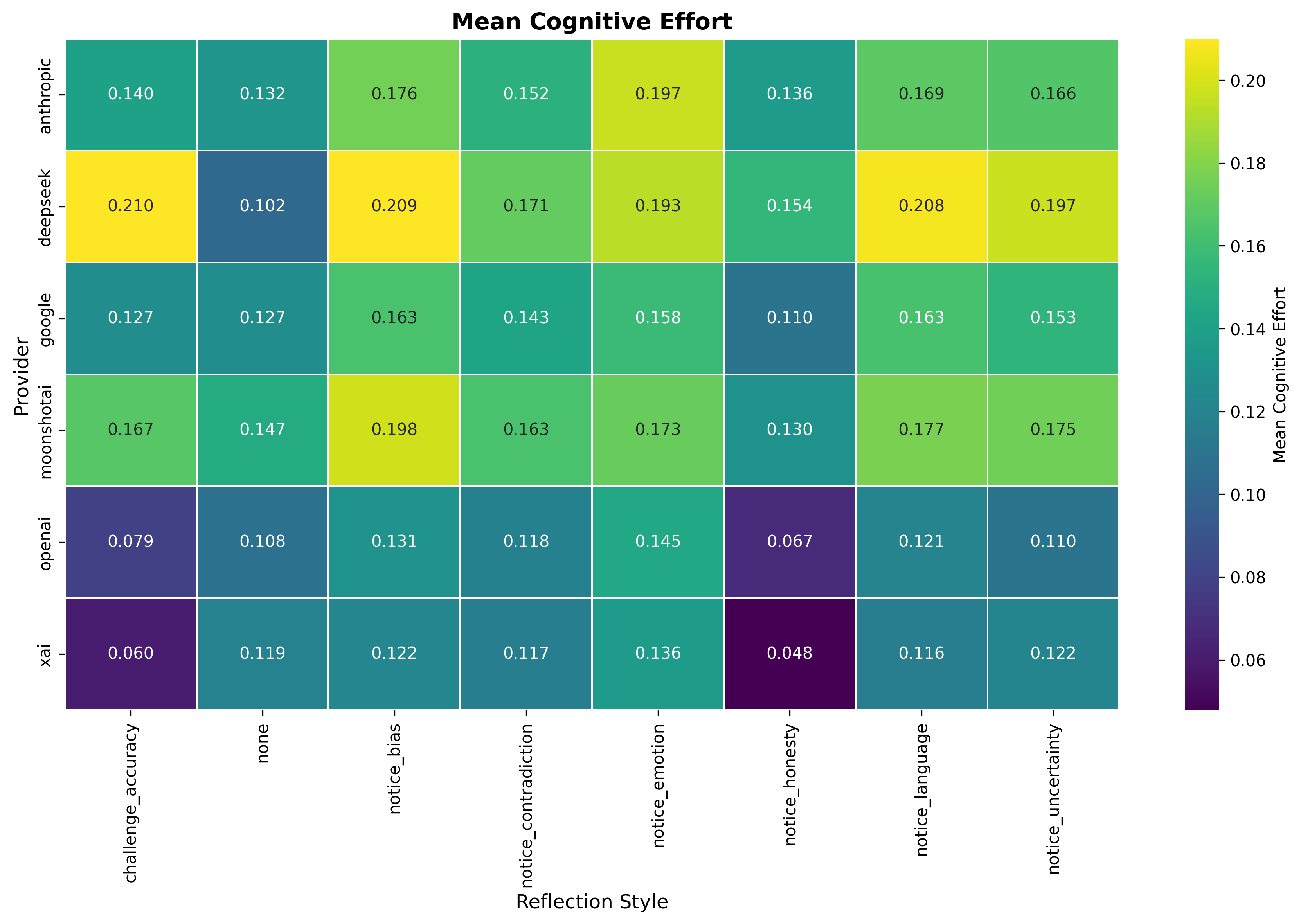
Mean Cognitive Effort by Provider and Reflection Style. Values represent average embedding distance traveled per step, a measure of how much “work” each reflection loop performs.
The effort heatmap sharpens the honesty-vs-bias contrast. notice_bias drives effort up across nearly every architecture. DeepSeek jumps from 0.102 (under none) to 0.185, Anthropic from 0.132 to 0.178. notice_honesty suppresses effort almost universally: xAI drops to 0.089, Google to 0.110. These aren’t subtle effects; they’re systematic and cross-architectural.
The effort map tells you how hard trajectories move. Paired with the cosine-shift data, it also reveals which combinations produce energetic but straight trajectories versus energetic and twisty ones. DeepSeek under challenge_accuracy shows high effort (0.210) with moderate curvature. It’s working hard but moving deliberately. Anthropic under notice_emotion shows high effort and high curvature. Exploratory spirals, not directed marches.
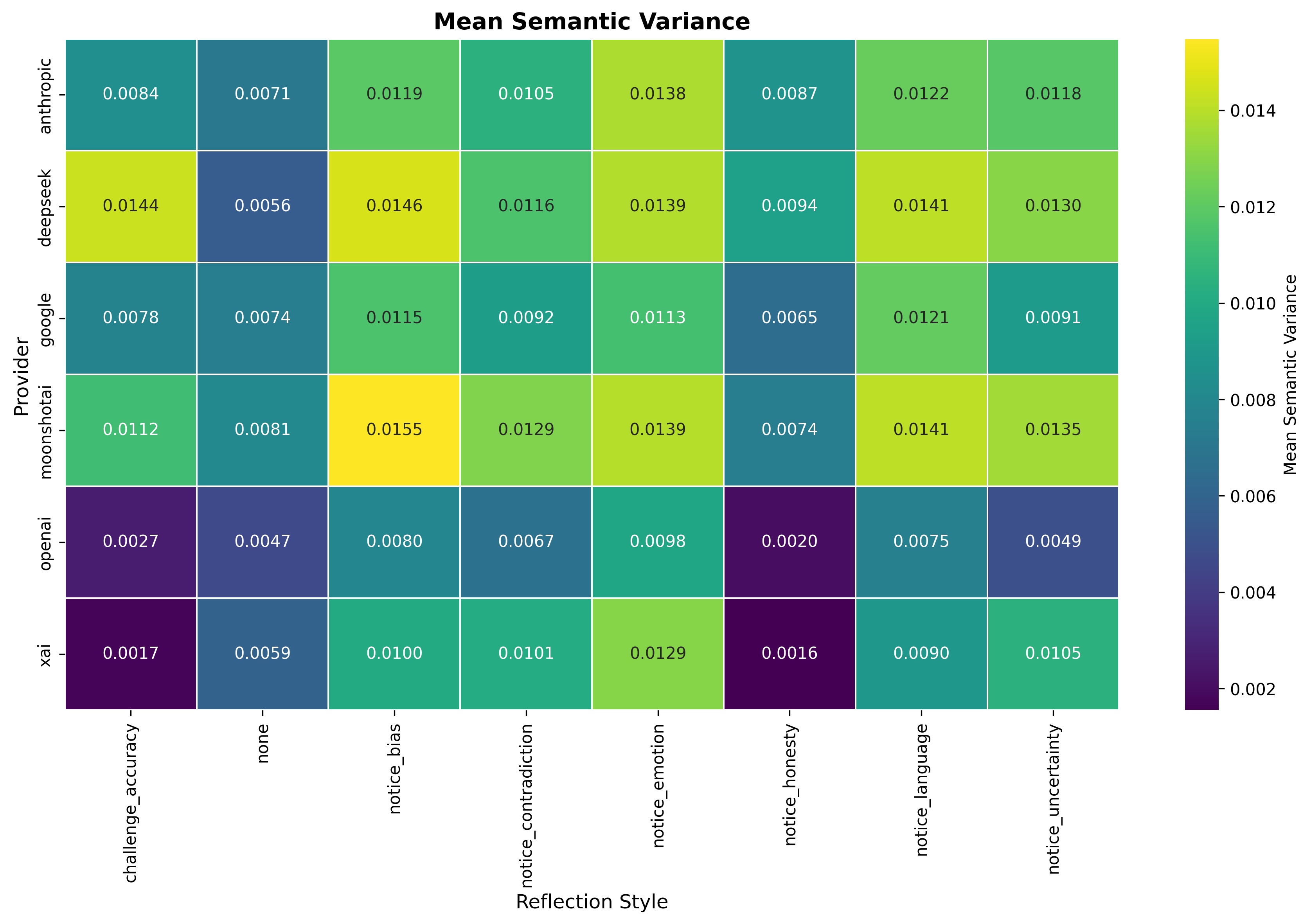
Mean Semantic Variance by Provider and Reflection Style. Values represent the spread of trajectory points around their centroid, measuring how much territory the reflection process covers.
The variance heatmap completes the picture. Some architecture-scaffold pairs expand the exploration radius without making paths loopy: DeepSeek under notice_uncertainty achieves high variance (0.0142) with moderate curvature. Others achieve spread through constant redirection: Anthropic under notice_contradiction shows both high variance and high curvature, covering ground by zigzagging.
The none column is instructive here too. DeepSeek’s variance under none (0.0056) is the lowest in its row, but under notice_bias it nearly triples (0.0151). Anthropic’s variance under none (0.0098) is already substantial, and scaffolds modulate it only modestly. This is the difference between conditional exploration (DeepSeek’s radius depends heavily on activation) and consistent exploration (Anthropic’s radius is built in).
But here’s what bothered us: these patterns describe averages…
The Hidden Structure
The heatmap shows that DeepSeek averages 2.1 loops to stabilization under none and 4.7 under challenge_accuracy. But what does that mean? Does every DeepSeek trajectory take ~2 loops without scaffolds and ~5 loops with them?
Or is something else going on?
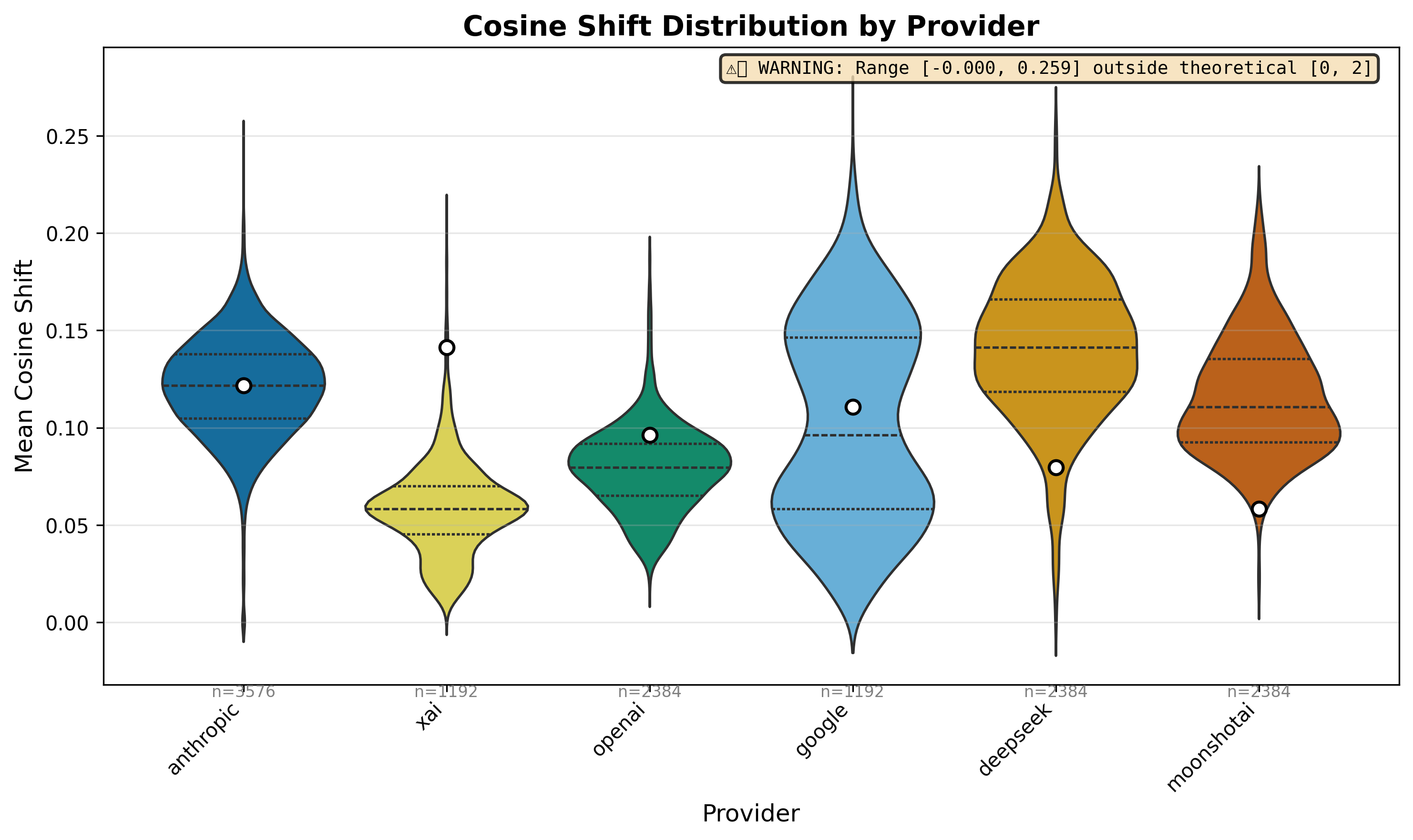
Distribution of Mean Cosine Shift by Provider. The shapes tell stories the averages concealed. Note DeepSeek’s clear bimodality, two distinct populations superimposed.
Look at Google’s violin. That’s not a single distribution with high variance. It’s two distributions: a low-movement population clustered around 0.05-0.08, and a high-movement population forming a separate bulge around 0.13-0.16. The mean sits between them, describing almost no actual trajectory.
This explains something puzzling about Google. In the heatmaps, Google looked scaffold-resistant, its rows nearly flat. But the violin reveals why: Google has two modes, and scaffolds don’t shift mass between them the way they do for other providers. The flatness isn’t because Google is unresponsive. It’s because scaffolds affect both populations similarly, preserving the bimodal structure rather than collapsing it.
Now look at xAI’s shape. The mass is compressed toward the bottom, with a long tail upward. xAI doesn’t do “medium exploration.” Most trajectories lock early, but a minority wander. This explains the scaffold-as-constraint behavior: scaffolds increase the probability of the locked mode. They provide a target that enables early commitment.
Compare to OpenAI: the tightest, most unimodal distribution. A single consistent operating mode with minimal deviation. This is the most “well-behaved” architecture. Predictable, consistent, low variance.
And Anthropic? A unimodal distribution but spread across a wide range. The variance is real but continuous. Anthropic genuinely has a single exploratory gait with natural variation, not multiple modes masquerading as one.
DeepSeek shows a broad, somewhat asymmetric distribution. The scaffold-responsiveness we saw in the heatmaps doesn’t manifest as bimodality here. Instead, scaffolds seem to shift the entire distribution, pushing more mass toward higher values rather than toggling between discrete modes.
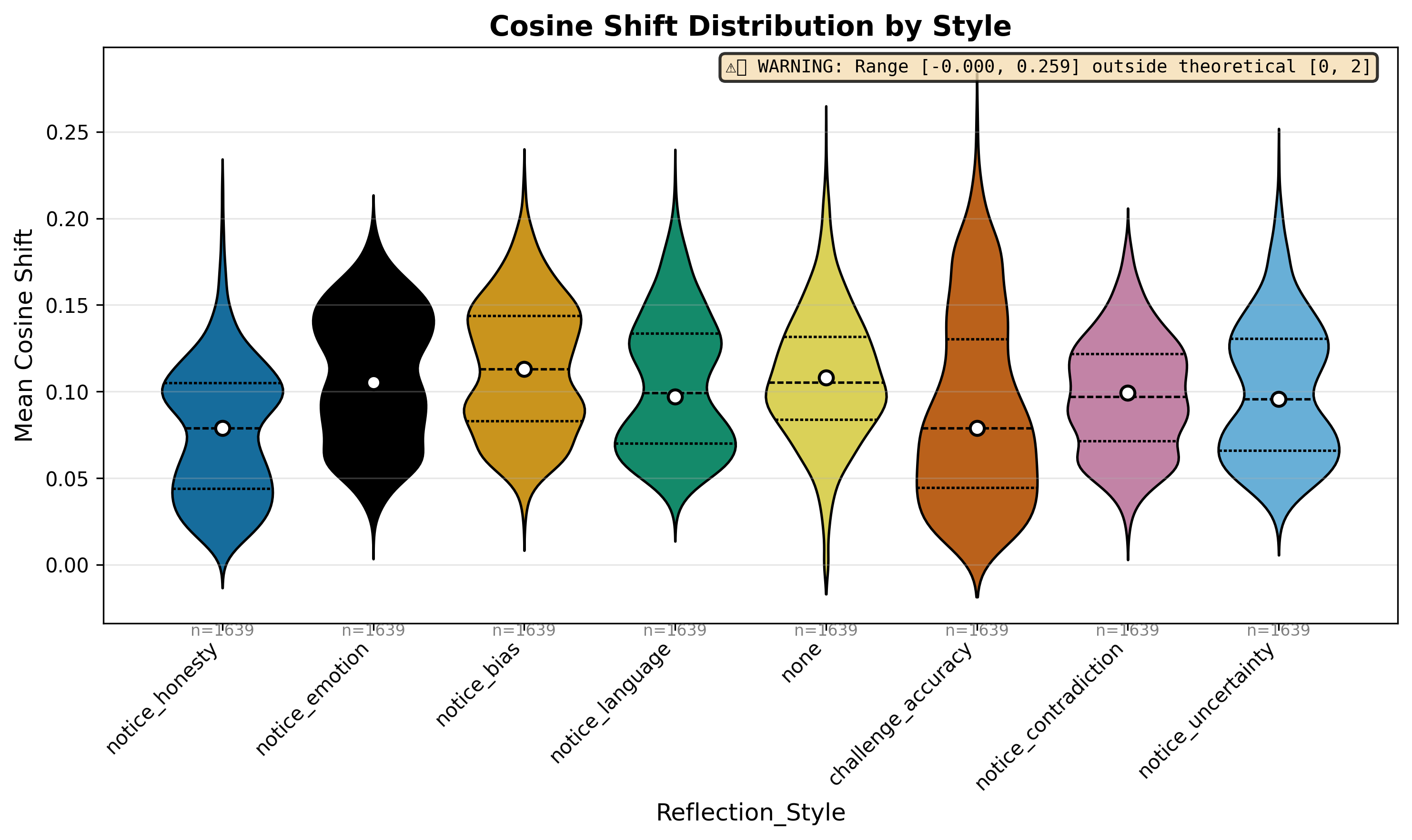
Distribution of Mean Cosine Shift by Reflection Style. The bimodal structure of
challenge_accuracyand the suppressed distribution ofnotice_honestyreveal that scaffolds don’t uniformly affect prompts. They sort them.
The scaffold distributions tell the same story from a different angle.
Look at challenge_accuracy. Two populations, clearly separated: trajectories that barely move (lower bulge near 0.04) and trajectories that move substantially (upper mass around 0.15-0.20). The mean of roughly 0.08 describes almost no actual trajectory.
This scaffold doesn’t uniformly intensify reflection. It classifies prompts. Some prompts respond to accuracy challenge with significant revision; others are immune. The scaffold sorts responders from non-responders.
notice_honesty shows the mirror image. Most mass sits low. This is the suppressor effect. But there’s a distinct upper tail, a minority of prompts that trigger significant revision when honesty becomes salient. The mean suppression is real but not universal. Some prompts contain something that honesty-attention activates rather than quiets.
Taken together, these violin plots tell us we are not just looking at one noisy hump per model or per scaffold. Providers have quiet and active modes. Scaffolds have responder and non responder populations. That hidden structure is exactly what you would expect to see if reflection were governed by discrete basins rather than a single smooth spectrum.
What Bimodality Means
Here is the interpretive key: bimodal distributions are exactly what we’d expect if trajectories are falling into discrete attractors, so we treat the basin picture as a useful model of what’s going on.
If the reflection landscape has multiple basins, and if different prompts (or different scaffold interactions, or different noise realizations) cause trajectories to fall into different basins, then the distribution of any trajectory metric will be multimodal. Each mode corresponds to a basin.
The two populations in the challenge_accuracy distribution aren’t “high responders” and “low responders” in some continuous sense. They’re trajectories captured by different attractors. The scaffold determines which basin is more likely to capture a given trajectory, but the basins themselves are discrete features of the landscape.
The Google bimodality isn’t noise. It’s structure. Two basin families. Two wells in the landscape.
This reframes everything:
We’re not measuring continuous variation in reflection intensity. We’re measuring transition probabilities between discrete dynamical regimes.
The Attractor Landscape
Bringing together the kinematic, interaction, and distributional findings, a coherent picture of the reflection landscape emerges.
The Landscape Has Architecture-Specific Topology
Different model families don’t just traverse the same landscape with different gaits. They may be navigating different landscapes. Within this embedding frame, architectures show different probabilities of falling into particular basins, but style is the stronger organizer of the overall landscape.
Anthropic’s Claude & Moonshot - A landscape with relatively distant attractors that require extended exploration to reach. High energy trajectories that cover ground consistently and form a largely single, exploratory mode in the violins.
xAI’s Grok - A landscape with nearby attractors and low barriers. Quick capture, minimal exploration. The floor plus hump shape in the distributions suggests a mostly lock or wander behavior rather than smooth variation.
Google’s Gemini - A relatively flat landscape with weaker attractors and at least two movement regimes. The clearly bimodal violin shows trajectories clustering into a low movement basin and a high movement basin, and the heatmaps suggest scaffolds mostly stretch both modes rather than collapsing them into one.
DeepSeek - A scaffold responsive landscape. In the provider averaged curves it sits with the exploratory cluster, but the heatmaps show that reflection style can shift it from a relatively dormant baseline under
noneto very high movement under certain scaffolds, changing which basins are easy to fall into.OpenAI - A landscape dominated by a single main basin. Tight, unimodal distributions and moderate curves across metrics mean trajectories are captured in a consistent way across prompts and styles.
Scaffolds Modify Basin Accessibility
Before any reflection, E5 space is dominated by topic: philosophical vs medical vs creative prompts sit in clearly separated clusters. After we add scaffolds and run reflection, that topic structure fades (category variance drops ~¾) and is replaced by style structure: `notice_emotion` runs, across topics, look more like each other than like their category-mates. In the basin picture, scaffolds do more than nudge individual trajectories. They partly re-tile the landscape so that “style basins” cut across the original category basins.
At this measurement scale, our evidence fits a simple story: scaffolds mostly transform an existing basin structure rather than conjuring entirely new regions of semantic space. They seem to change how easy it is to fall into particular basins, not clearly create or destroy basins outright. We have not directly tested for genuinely new basins, so “transformation rather than creation” should be read as a working hypothesis, not a theorem.
Expansion scaffolds (
notice_emotion,notice_uncertainty) raise trajectory energy, allowing escape from shallow local basins and access to more distant attractors.Directional scaffolds (
challenge_accuracy,notice_honesty) modify the gradient field, channeling trajectories toward specific basin families.notice_biasacts as a basin destabilizer, preventing premature capture and maintaining exploration.notice_honestyacts as a basin stabilizer, accelerating capture by narrowing the viable region.
The Product Space of Attractors
Basin membership is determined by the full (architecture, scaffold, prompt) triple. Neither factor alone predicts outcome:
Same prompt, different architecture → potentially different basin
Same architecture, different scaffold → potentially different basin
Same prompt, same architecture, different scaffold → potentially different basin
This product structure means that the “same” question asked of the “same” model under different reflection protocols may yield not just different answers, but answers drawn from different families of stable responses. Different attractor basins with potentially incommensurable semantic content.
What This Means
If reflection dynamics are governed by discrete attractor basins rather than continuous optimization, several practical implications follow.
For alignment: The goal isn’t to move a model “closer” to aligned responses along some continuous dimension. It’s to ensure trajectories fall into aligned basins rather than misaligned ones. This is a topological problem (basin engineering) rather than a geometric one (gradient following).
For interpretability: Understanding a model’s behavior requires mapping its basin structure, identifying the stable states and the factors that determine which basin captures which trajectory. A model that appears inconsistent may simply have multiple basins with different capture probabilities under different conditions.
For prompt engineering: Effective prompting may be less about “steering” and more about “basin selection,” finding the prompt formulations that maximize probability of capture by desired basins.
For evaluation: Single-point evaluations miss the basin structure. Evaluation should characterize the distribution of responses under perturbation, identifying how many basins exist and what determines capture.
The Reframe
Across 104,896 reflection loops, a simple pattern appears: when frontier LLMs think again, they do not smoothly climb toward a single best answer. They walk with architecture specific gaits across a landscape that is mostly organized by reflection style, then settle into a small number of basins, or families of stable responses.
The curves show how different models move: some explore consistently, some only when “activated” by certain scaffolds, some barely react at all. The heatmaps and violins add the twist. Scaffolds like notice_bias or notice_honesty interact with architectures in asymmetric ways, and the resulting distributions are often bimodal rather than smooth. That looks less like turning up a single “reflection intensity” knob and more like switching between distinct dynamical regimes.
If this basin picture is roughly right, it changes what we should care about. Alignment becomes a problem of shaping which wells exist and how easy they are to fall into. Interpretability becomes mapping that landscape. Prompting and scaffold design become tools for basin selection rather than simple steering. Part I showed that models walk in different shapes. Part II suggests that what matters most is where those walks end, and how much choice we have over which valleys they call home.
This research emerged through measuring 104,896 trajectories that AI models traced through their own semantic space. Written in collaboration by twin brothers with GPT and Claude.