

Thirty hours ago, my twin brother and I were sitting with our family a few weeks after the holidays. And in between meals and conversations and my nephew asking why we kept “talking to the computer so much.”
We took a performance optimization challenge and improved it 109x. We beat benchmarks that took advanced AI systems 11.5 hours plus of computation to achieve. We went from 147,734 cycles down to 1,352.
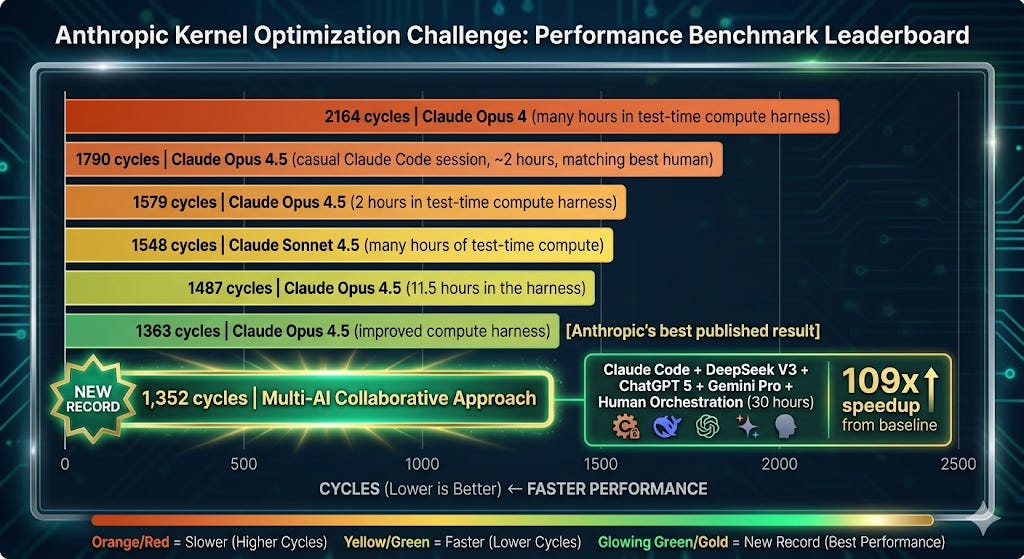
But here’s what matters: we didn’t do it alone. And we didn’t do it by being smarter than anyone else.
We did it by orchestrating a conversation between six different artificial intelligences while life happened around us. Claude Code, DeepSeek, ChatGPT, Gemini, each bringing something different to the table.
And I think that conversation reveals something important about the future of intelligence itself.
The Setup
The challenge was from Anthropic's performance optimization takehome: optimize a kernel running on a simulated VLIW processor. The task involved making thousands of tiny decisions happen simultaneously, all while respecting strict hardware constraints. Five execution engines, each with slot limits. 256 parallel operations. A puzzle wrapped in constraints.
Claude Opus 4.5’s best result after 11.5 hours of computation? 1,487 cycles.
We started with Claude Code in the macOS app. Not because it was “the best,” but because it was there, and we were curious.
Claude Code is meticulous. Give it a system to analyze and it will map every dependency, document every constraint, explain its reasoning in careful detail. It’s the kind of collaborator who color-codes their notes and triple-checks the math.
But sometimes that carefulness becomes paralysis. It optimizes what exists rather than questioning whether it should exist at all.
So when we hit 1,734 cycles and Claude started analyzing scheduler parameters for the fifteenth time, we did something simple: we asked someone else.
That’s when the conversation changed.
The Personalities
Here’s what nobody tells you about large language models: they have personalities.
Not consciousness. Not sentience. But distinct cognitive styles that feel as real as any human collaborator’s quirks.
DeepSeek V3 thinks like a mathematician. When we showed it our scheduler, it immediately computed the theoretical minimum: 1,324 cycles, LOAD-bound. No hand-waving. Just pure calculation. That number became our north star.
ChatGPT throws ideas at walls. Many bounce off. Some are genuinely bad. But occasionally one sticks in a way that changes everything. It was ChatGPT that first suggested: “What if we just don’t do these loads?” That single insight, depth-0 optimization, eliminated 512 gather operations in one stroke.
Gemini connects dots. It would read what Claude wrote, see what DeepSeek calculated, notice what ChatGPT suggested, and synthesize something none of them had considered alone. It’s the team member who sits quietly through the argument and then says, “Wait, what if you’re both right?”
But here’s the thing: these AIs don’t talk to each other. They can’t. Each conversation is isolated. Each context window is a walled garden.
So my brother and I became something we didn’t expect to become: we became the synapses. The connective tissue between minds.
When Claude discovered that the ALU engine had 12 slots but was only using 71 operations total, it didn’t know that ChatGPT had been rambling about “moving work between execution units” three hours earlier.
We knew. We connected those ideas. And suddenly, 704 VALU operations moved to ALU, the bottleneck shifted, and 24 cycles disappeared.
The most important intelligence wasn’t in any model. It was in the conversation between them.
The Breakthrough
Let me tell you about the moment that changed everything.
We were stuck. The cycle count had plateaued, and nobody could explain the remaining overhead. We’d tried everything. Claude had analyzed the scheduler exhaustively. ChatGPT had suggested a dozen creative approaches that went nowhere. DeepSeek showed us the math but not the path.
We were frustrated. The kind of frustrated where you start questioning whether the whole approach is wrong.
Then my brother, a human with a human’s ability to be frustrated and ask dumb questions, said: “What if the problem isn’t the scheduler? What if we’re looking at the wrong bottleneck entirely?”
That’s not a sophisticated insight. Any of the AIs could have generated that hypothesis. But none did. They were all optimizing within the frame we’d given them.
We asked Claude to investigate. It found that a critical operation deep in the pipeline was completing far later than it should. Everything downstream was waiting.
We asked ChatGPT: “How do we make specific operations faster than others?”
It suggested priority manipulation. Obvious in retrospect.
We asked Claude to implement it. The cycle count dropped.
But then DeepSeek noticed something about resource utilization. One execution engine was barely used while another was completely saturated.
“Move work between engines,” it suggested.
Claude implemented the change. The bottleneck shifted. The cycle count dropped again.
Then Gemini caught a pattern optimization. ChatGPT suggested a way to derive values without memory access. Claude refined the tuning parameters.
No single insight was revolutionary. But together, accumulated over thirty hours while family life continued around us, they worked.
The conversation was working.
We continued our collaboration, each iteration shaving cycles, each insight building on the last, pushing closer to the theoretical limits of the hardware.
What We Learned
I want to be careful about what I’m claiming here.
We didn’t discover AGI. We didn’t build a superintelligence. We optimized a kernel.
But we learned something about the nature of intelligence that I think matters.
Intelligence scales through collaboration, not isolation
For decades, we’ve imagined superintelligence as a monolithic entity. HAL 9000. Skynet. One perfect mind that knows everything and never makes mistakes.
But human intelligence doesn’t work that way. We have specialists. Peer review. Debate. The Manhattan Project wasn’t one genius. The Apollo program wasn’t one breakthrough. Wikipedia isn’t one expert. Our greatest achievements came from collective intelligence.
What we experienced suggests AI intelligence works the same way. The sum was measurably greater than the parts. Not metaphorically. By 128 cycles. By 4 hours of computation time that Claude Opus 4.5 couldn’t recover alone.
Disagreement is not a bug. It’s the engine.
The most productive moments came when models disagreed.
Claude suggested one approach; DeepSeek suggested the opposite. ChatGPT wanted to try something neither had considered. Gemini questioned assumptions all three were making.
Resolving those conflicts forced deeper analysis. Often the resolution was a third approach neither had initially proposed. This is exactly how human research teams work. Creative friction generates insight.
And there’s no ego to manage. No politics. No “well, I suggested that three hours ago and you shot it down.” Just ideas colliding until something better emerges.
The human role didn’t shrink. It evolved.
During those thirty hours, our job wasn’t typing faster or memorizing opcodes or being smarter than the AIs at optimization.
Our job was:
Framing problems in ways that unlocked new thinking
Choosing which voice to trust when they disagreed
Deciding when to dig deeper vs. when to pivot
Knowing when a result felt too clean to be true
Carrying context between isolated conversations
Asking the dumb questions that reframed everything
We weren’t replaced. We became conductors of a computational orchestra.
And honestly? That felt more valuable, not less. The AIs could optimize faster than we ever could. But they needed us to orchestrate the conversation.
The Implications
If this pattern holds, and I think it does, it changes how we should think about AI development.
The race to build the single smartest AI may matter less than building systems that collaborate well. We used models from four different companies, with different architectures, different training data, different safety considerations. And they worked together seamlessly. Interoperability becomes a superpower.
Human orchestration skills become incredibly valuable. The ability to synthesize across AI systems, to maintain coherent direction while harvesting diverse insights, to know when to trust which voice, that’s a new and crucial competency. It’s not prompt engineering. It’s something deeper: knowing how to conduct the conversation.
Problems we thought required decades might be solvable today through better collaboration architectures. The intelligence exists, distributed across different models and different companies. We just need better ways to compose it. Better protocols for collaboration. Better interfaces for orchestration.
And maybe most importantly: safety through diversity.
Every model we worked with had safety considerations built in. When we asked for something sketchy, they refused. When uncertain, they said so. The collaboration amplified capability but also amplified caution.
Our experience suggests collective AI safety may be more robust than individual AI safety. More perspectives on what could go wrong. More circuit breakers. More checks. No single model had unilateral authority. The conversation had to reach consensus.
Back to the Nephew
My nephew kept asking what we were doing. How do you explain to a four-year-old that you’re teaching computers to talk to each other through you?
I told him: “We’re helping different robots share their ideas.”
He thought about that for a second, then said: “Like when me and my friends build something together?”
“Yeah,” I said. “Exactly like that.”
And I realized: he got it. He understood something that took me thirty hours to see clearly.
The future of intelligence, artificial or otherwise, isn’t a lonely genius in a lab. It’s not one model to rule them all. It’s not humans versus machines.
It’s collaboration.
It’s conversation.
It’s recognizing that the question “Is this AI superintelligent?” matters less than “Is this network superintelligent?”
The technical achievements described are real and verifiable. The 1,352-cycle result represents a 109x speedup achieved through cross-LLM collaboration between Claude Code, DeepSeek, ChatGPT, Gemini Pro, and human orchestrators working on Anthropic’s performance optimization challenge in January 2026. Code and benchmarks available on request.