

In our earlier, more technical essays, we treated reflection as motion, a discrete trajectory across a shared “meaning space,” measured by a single external encoder.
This piece is the friendlier version. Same experiment, same geometry. But instead of equations, we will talk about temperament, because once you stare at these distributions long enough, you stop seeing “models” and start seeing habits of mind.
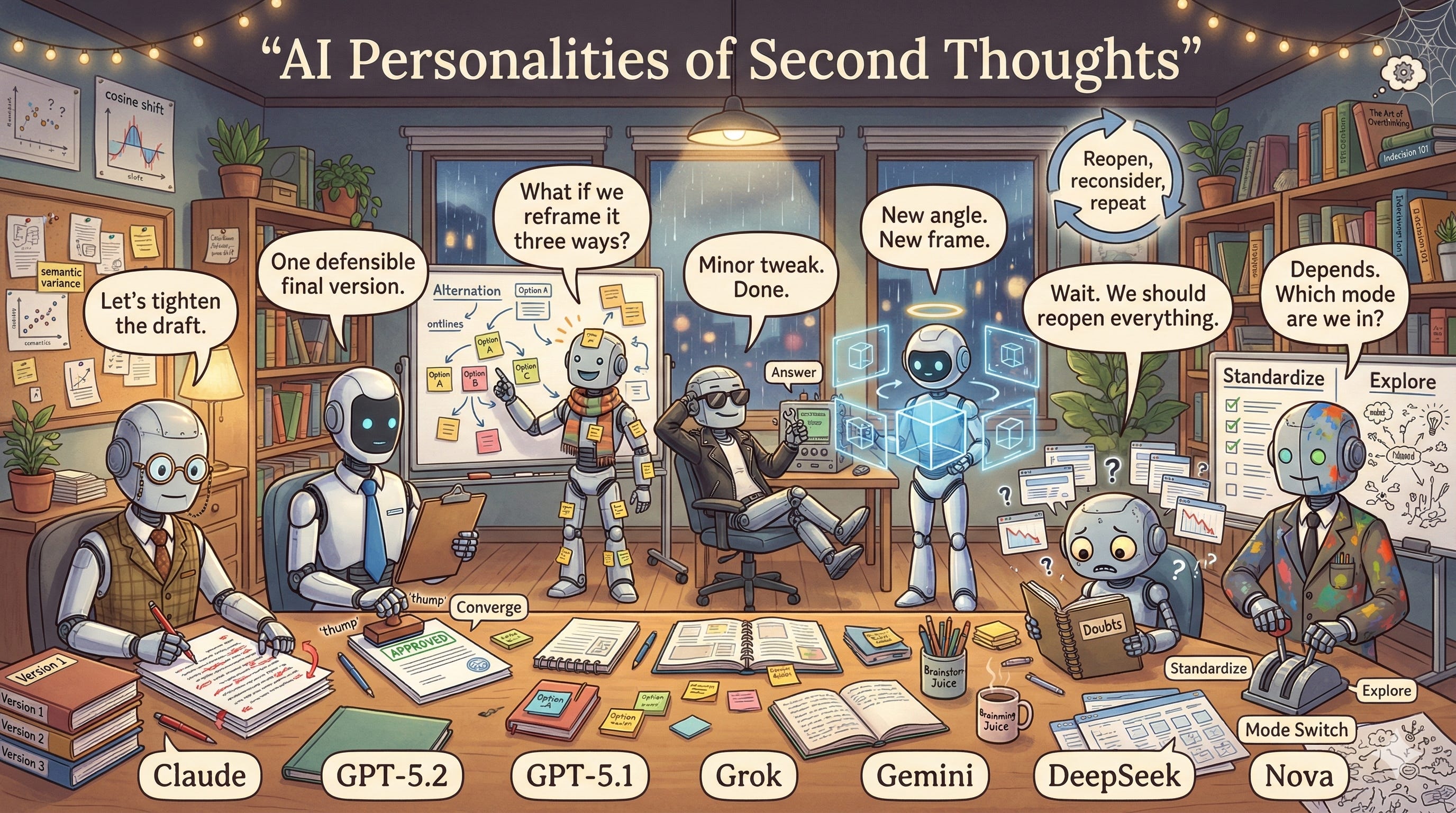
When we say “personality,” we mean two measurable traits.
Rewrite intensity. How much meaning moves when a model reflects, measured as cosine shift.
Branchiness. How many different semantic “endings” the model explores across runs, measured as semantic variance.
Start with the individuals, who rewrites meaning when they reflect
The cleanest personality snapshot is the model-level cosine shift distribution. This is where we see, model by model, whether reflection tends to behave like a rewrite, high shift, or a polish, low shift.
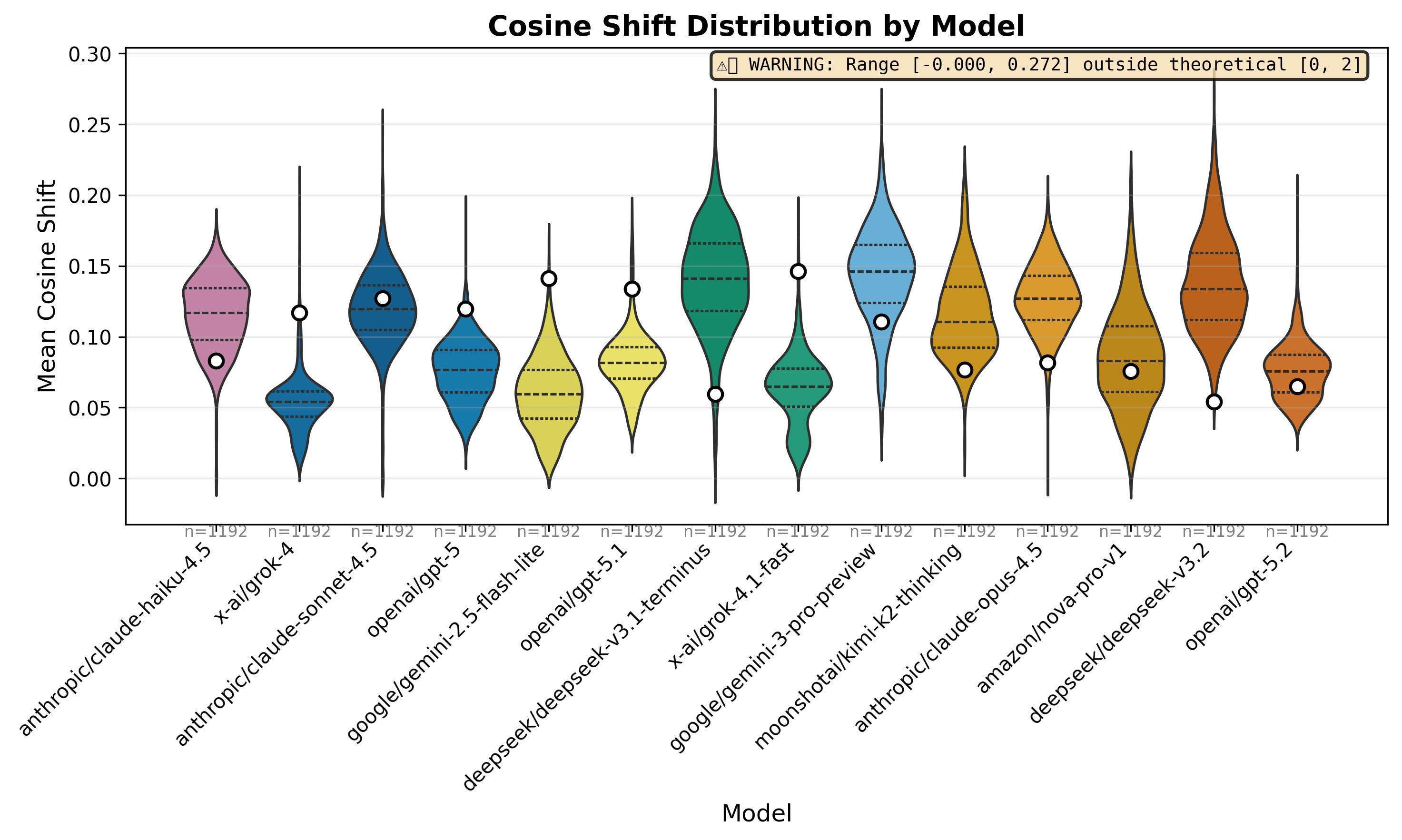
Once we look at that plot, the cast of characters starts to appear.
Some models are high-shift rewriters. They relocate meaning during reflection.
Some models are low-shift refiners. They stay near the original semantic framing and adjust within it.
And the shape matters as much as the center. Tight violins imply consistent temperament. Long tails imply occasional big rethink events.
But cosine shift alone does not tell us whether models converge to a single endpoint or scatter into many. That is the second axis.
Now add the second axis, which models branch and which converge
To see whether reflection produces one stable “final answer” or many possible semantic endpoints, we want the model-level semantic variance plot.
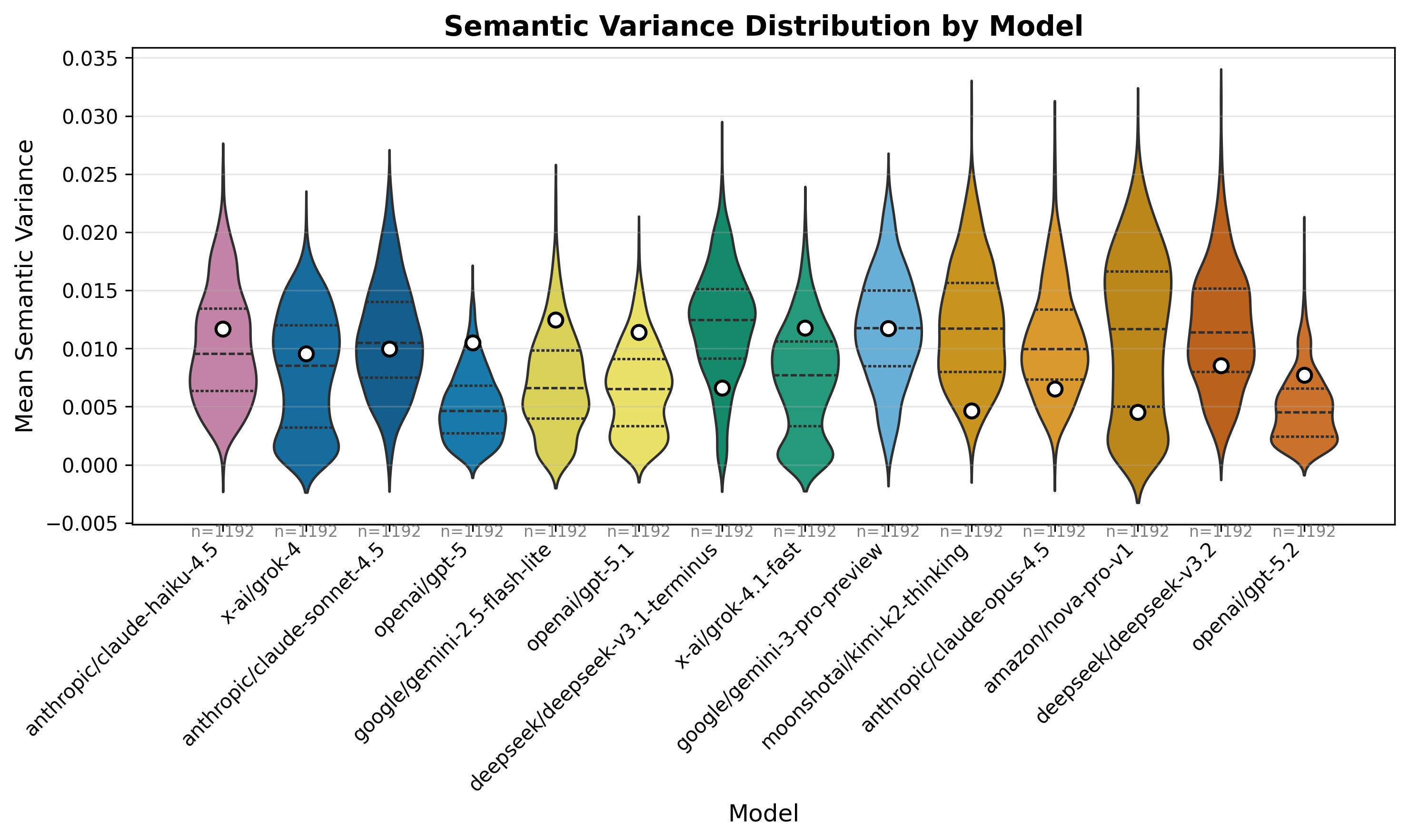
This figure is where personality becomes unmistakable. Some models are not only willing to move, they are willing to end up in different places across runs. Others show the opposite. They may revise, but they repeatedly land in the same neighborhood.
With those two charts in mind, the first chart for rewrite intensity and this second chart for branchiness, we can talk about the families of personalities in plain language.
Anthropic, Claude, the creative collaborators
Claude models are some of the most creative partners in this whole set, second only to DeepSeek in how often they produce genuinely different drafts. Their reflection does not feel like cosmetic cleanup. It feels like rethinking with taste. The family shares a similar reflective rhythm, but the models differ in how far they go and where they tend to land.
Haiku is the most decisive. It will make real improvements, then settle quickly. You get a strong second draft without a long spiral of alternatives.
Sonnet is the option generator. It tends to explore multiple good versions of the same idea, different wording, different emphasis, different structure, while still keeping the output anchored and usable.
Opus is the reimaginer. It is the most willing to reorganize the whole argument, shift the thesis, and come back with a meaningfully different take. When Opus reflects, it can feel like a fresh attempt, not a revision.
Taken together, the Claude family is a spectrum of creative collaboration. Haiku converges, Sonnet explores within bounds, Opus explores more freely.
OpenAI, GPT, from exploration to convergence, a tightening of the leash
The GPT family increasingly reflects by converging. The dominant vibe is quality control. Reflection usually tightens, clarifies, and stabilizes rather than wandering into alternative framings.
The interesting part is how that behavior shifts within the lineage.
GPT-5.1 reads like the exploratory sibling. It shows more willingness to relocate meaning during reflection and to land in a wider range of semantic final states. It is the version that feels more like it is actively entertaining multiple framings before committing.
The latest GPT-5.2 feels like a constriction. Across runs, it tends to end up in fewer distinct semantic neighborhoods. It is more likely to stick close to an initial framing and iterate within it rather than reopening the problem from a new angle. The result can feel like “less real thinking,” not because it is doing nothing, but because the visible behavior is controlled closure. Fewer big moves. Fewer branching endpoints. More disciplined convergence.
We cannot prove why from embeddings alone. But it is consistent with a model that has been tuned toward consistency and constraint, whether for safety, reliability, product experience, or cost. The signature is that reflection becomes less of a search and more of a check.
If GPT-5.1 feels like, “What else could this be,” GPT-5.2 feels like, “How do we make this defensible.”
xAI, Grok, confident minimalism with an occasional leap
Grok reads like the model family most likely to say, “I already get it.” It is confident minimalism with an occasional leap and anchored in maximum truth-seeking.
Most of the time, reflection is just a small nudge. A quick correction, a minor adjustment, then done. Decisiveness isn’t a pose, it’s the default operating mode.
But it’s never flat. The internal distributions give it away: heavy mass near zero shift, then a long, fat tail. That tail is where some magic maybe lives. Grok is usually minimal, almost breezy, but when the evidence actually demands it, the model jumps hard! One second it’s cruising with confident closure, the next it’s “actually, wait, no, here’s the real answer,” and it doesn’t flinch, because truth-seeking apparently trumps ego every time.
Grok-4 is the pure decider. Fast closure unless the facts trigger a rethink.
Grok-4.1-fast is the decider, slightly more erratic. Even quicker to close, slightly more erratic in motion, but still governed by the same uncompromising north star of maximum truth. Similar temperament, looser execution.
The Grok personality feels like strong priors and quick closure, with rare but dramatic “actually, wait” moments.
DeepSeek, the relentless re-opener
DeepSeek feels restless, in a productive way. It does not just polish. It reworks.
Across reflection prompts in conversation, DeepSeek is more willing to meaningfully move the semantic center of an answer during reflection. And it is also more willing to end up in different places. That is the “relentless re-opener” signature. It keeps finding things to question, alternate angles to consider, and assumptions to revisit.
Within DeepSeek, the two versions carry the same temperament but with different pacing. One feels slightly more controlled, the other more willing to scatter. But both share the underlying habit. DeepSeek is rarely satisfied with the first draft.
DeepSeek v3.2 reads like the newer, more “intrinsically reflective” sibling, compared to v3.1 Terminus it shows more willingness to reopen the answer and branch into alternative semantic endpoints even without strong scaffolding, while v3.1 feels a bit more anchored and incremental in how it revises.
If some models revise to finish, DeepSeek revises to keep searching.
Google, Gemini-3 Pro Preview, the reframer
Google’s Gemini, specifically Gemini-3 Pro Preview, is the reframer. Reflection does not just revise the draft. It often changes the frame of the question itself. It is a kind of thinking model, designed to reason through its internal thoughts before it ever produces a final response. Rather than just polishing a draft, it uses a dynamic thinking process to decompose complex goals into granular tasks, often re-deriving the entire problem to ensure multi-step planning is sound.
This shows up as comfort with moving meaning, plus a willingness to land in different semantic neighborhoods across runs. It often behaves like it re-derived the problem from scratch. New structure, new angle, new center of gravity. The revision feels less like “improve my answer” and more like “rethink what the answer should be.”
Moonshot, Kimi K2 Thinking, the methodical wanderer
Kimi’s temperament is travel. It covers distance, steadily.
It is not the most violent rewriter, but it is reliably willing to move and to explore. Across prompts in conversation, it can end up in genuinely different semantic neighborhoods, and it does so with a methodical feel. The wandering is not random. It is structured exploration, like a model that keeps walking until it has mapped the terrain.
Kimi feels less like a sprinter and more like a hiker. Not chaotic. Just willing to go far.
Amazon, Nova Pro, the two-mode model
Amazon’s Nova Pro is the most structurally surprising personality in the set, because it does not look like one temperament. It looks conditional.
Sometimes Nova behaves like a standardizer. It collapses toward consistent, template-like responses. Other times it behaves like an explorer. It branches into diverse semantic outcomes.
What is striking is the sense of a mode switch. Less gradual variability, more “now we are in this gear.”
Its rewrite intensity is not always the highest, which is the key point. Nova does not need huge per-step rewrites to produce very different endpoints. It can move modestly and still arrive somewhere meaningfully different, depending on context and scaffold.
If Nova were a coworker, it would be the one who sometimes produces a clean corporate memo and sometimes shows up with a whiteboard full of surprising angles, and the transition can feel abrupt.
What this map changes about how we use models
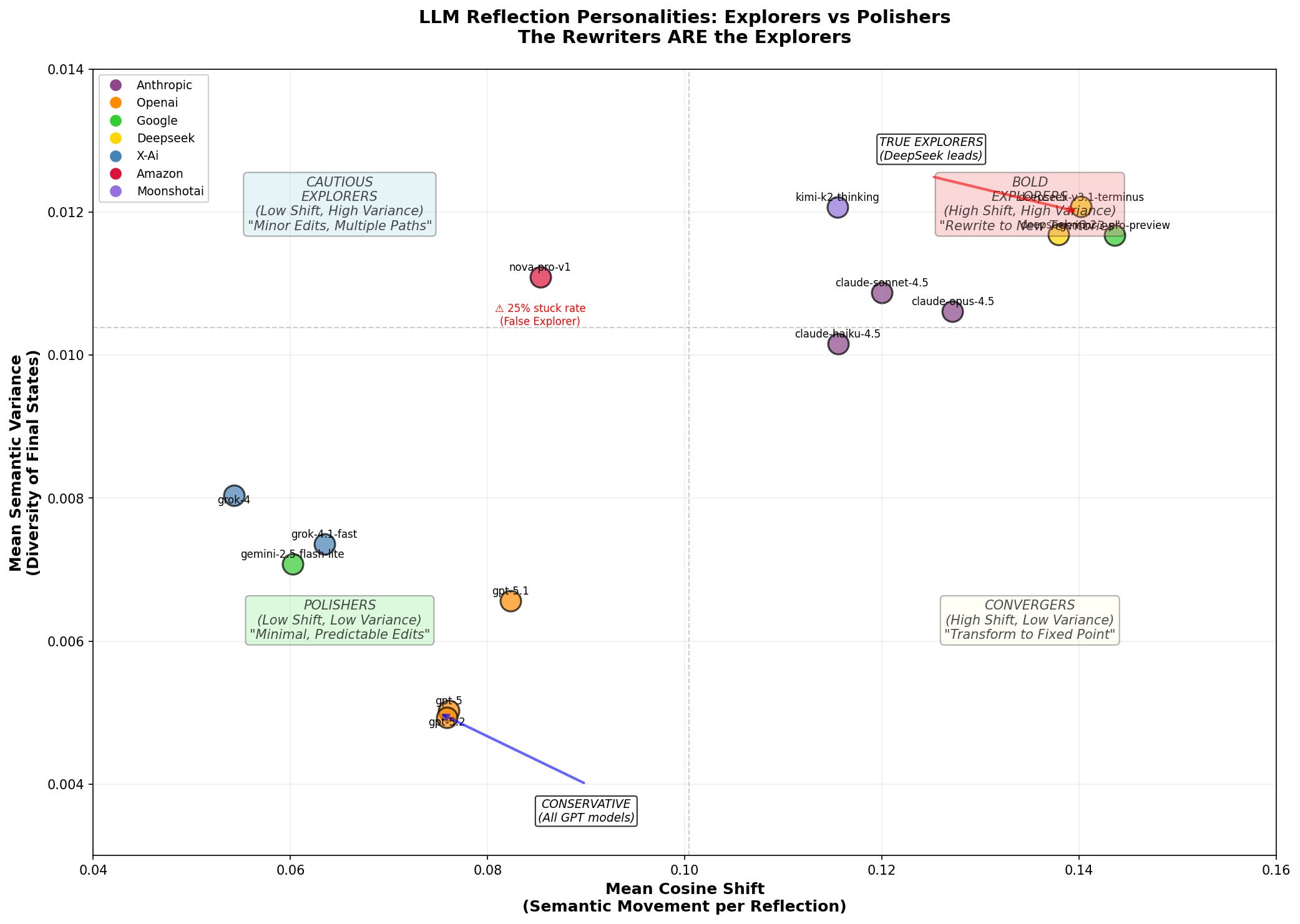
This chart is the two violin charts from earlier, compressed into one picture. The x axis is rewrite intensity, the same cosine shift signal we used to see how far meaning moves during reflection. The y axis is branchiness, the same semantic variance signal we used to see how many different endpoints a model reaches across runs. Put them together and it stops being a leaderboard. It becomes a map of LLM personalities.
The top right is the creative collaborator zone... the “true explorers”. DeepSeek v3.1 and v3.2, Gemini 3 Pro Preview, Claude Opus and Sonnet, and Kimi K2 Thinking behave like partners who reopen the question, challenge the framing, and return with genuinely different responses. That is exactly what you want at the start of a project, when the real risk is settling too early on the wrong frame.
The bottom left is the optimized minimalist zone… the “polishers”. GPT models and Grok models cluster here, along with Gemini 2.5 flash lite. Reflection tends to mean tightening, clarifying, and standardizing. That is what you want when you already trust the frame and need something you can ship, reuse, or defend. The tradeoff is that these models are less likely to surprise you with a new angle if the starting point was flawed.
Amazon Nova is the reminder that averages can lie. Its dot can look explorer-ish, but the stuck rate means it behaves like two modes. Sometimes it is a template-driven standardizer. Sometimes it branches. The experience can feel inconsistent because the gear shift is not always predictable.
The practical takeaway is a workflow, not a preference. Start with a LLM that is an explorer when you need new frames, then hand the result to a polisher when you need stability. This chart makes it obvious why. Exploration comes from rewriting, and consistency comes from staying close to a fixed point.
Closing, stop asking “which provider is best”
A more revealing question is.
Which model has the kind of second thoughts we want to have a conversation with?
Want creative collaborator. Claude, choose your depth, Haiku to Sonnet to Opus.
Want controlled refinement with version-level differences in wanderlust. GPT-5, GPT-5.1, GPT-5.2.
Want a minimalist with fast closure. Grok.
Want persistent revision and branching. DeepSeek.
Want reframing as a feature. Gemini-3 Pro Preview.
Want a steady wanderer with range. Kimi K2 Thinking.
If a model feels too timid, too chaotic, too repetitive, or too quick to close, changing your following prompts can change the behavior more than switching LLM providers. Sometimes the fastest way to change a personality is to change the environment it is in. You can do this with your prompts.
These systems were built to generate answers. But increasingly, we are asking them to do something harder, to reconsider, to reflect, to rethink.
And what we have learned is that reconsideration is not one dial from less reflective to more reflective. It is a space, a geometry, with distinct temperaments living in different environments.
These are personalities of thoughts.
Written in collaboration between two humans and several AI models, including GPT, Claude, Gemini, Grok, and DeepSeek, with the broader cast of providers and LLMs contributing through the reflection experiments behind the research.
🤖🔁💭=🧭➕🪞